


Buying your first property in the UAE is a major milestone. It often begins with finding the right home loan for first-time buyers in Dubai, but the journey does not end at approval.
For many buyers, the real challenge starts after purchase. Managing repayments, understanding rate changes linked to EIBOR (Emirates Interbank Offered Rate), and planning future financial decisions can feel complex. This is where ongoing mortgage support acts as a reliable safety net.

A Glimpse of Reality for the First-Time Buyer
First-time buyers are not just choosing a home. They are committing to a long-term financial structure shaped by UAE lending regulations and market conditions.
Common challenges include:
- Selecting between fixed and variable mortgage structures
- Understanding how EIBOR or profit rates affect repayments
- Managing affordability within lending limits
- Planning upfront and ongoing ownership costs
- Knowing when to review or adjust the loan
Understanding Eligibility and Financing in the UAE
Mortgage eligibility in the UAE is structured and regulation-driven.
Financing limits vary by residency. UAE nationals can access up to 85 per cent financing, expat residents up to 80 per cent, and non-residents typically 60 to 65 per cent.
Banks evaluate borrowers based on income stability, employment history, and credit profile. A key metric is the Debt Burden Ratio, usually capped at 50 per cent of monthly income. The AECB credit score, along with documents such as salary certificates and bank statements, plays an important role in the approval process.
Buyers should also plan for additional costs, including down payment, processing fees, valuation, transfer charges, and insurance. These can add around 5 to 7 per cent to the total property value.
Why Ongoing Mortgage Support Matters
Mortgage support should extend beyond approval.
Most UAE mortgages shift from fixed rates to EIBOR-linked variable rates after the initial period, meaning repayments can change over time. Even small rate movements can significantly impact long-term costs.
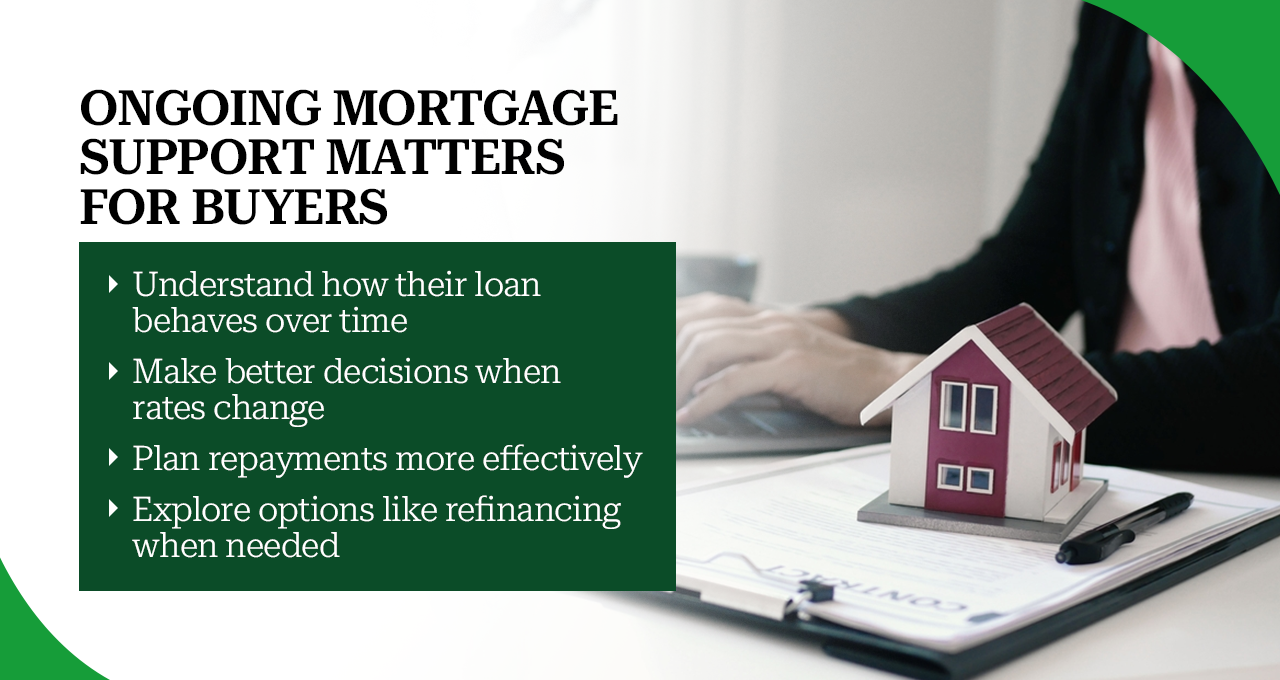
With ongoing support, buyers can:
- Track EIBOR trends and repayment changes
- Understand loan behaviour over time
- Make informed decisions when rates shift
- Plan repayments and prepayments effectively
- Explore refinancing or buyout opportunities
How Prime Rate Hub Strengthens the Safety Net
At Prime Rate Hub, the focus is not just on securing a mortgage, but on managing it effectively.
We track UAE interest and profit rate movements, including EIBOR, and translate them into clear insights. This helps buyers understand how market changes affect their repayments.
We also guide clients at key moments, such as:
- End of fixed-rate periods
- Market rate changes
- Refinancing opportunities
- Changes in financial position
This structured approach helps first-time buyers make informed, timely decisions.
Building Confidence Beyond the First Purchase
For many, the first property is just the beginning. Buyers may later explore rental income or property investment.
Ongoing guidance provides the clarity needed to move from basic ownership to structured financial planning, reducing uncertainty in future decisions.
A Smarter Way to Start Your Property Journey
Choosing a home loan is only the first step. Long-term success depends on how well that decision is managed.
With consistent mortgage guidance, buyers can stay informed, act at the right time, and avoid costly mistakes. Ongoing support provides the stability needed to navigate the UAE property market with confidence.
Related guides and services
- Mortgage eligibility in the UAE
- Mortgage down payment guide
- Mortgage calculator
- How Much Mortgage Can I Get in Abu Dhabi? (2026 Guide with Real Examples)
- Mortgage Process in Abu Dhabi: Step-by-Step Guide for Buyers (2026)
- Mortgage Pre-Approval in Abu Dhabi: What You Need, How It Works, and Why It Matters (2026 Guide)
Frequently Asked Questions
This usually depends on your residency status. If you’re a UAE national, you’ll typically need around 15% of the property value (for homes up to AED 5 million). Expat residents usually need about 20%, while non-residents may be asked to put down 40% or even more, depending on the bank and the property.
There’s no one-size-fits-all answer here. Banks look at your income, existing debts, and overall credit profile. That said, expat residents can usually borrow up to 80% of the property value, while UAE nationals may get up to 85%, as per central bank guidelines.
EIBOR (Emirates Interbank Offered Rate) is basically the benchmark interest rate used by banks in the UAE. Once your fixed-rate period ends, your mortgage often shifts to a variable rate based on EIBOR plus the bank’s margin. So, if EIBOR goes up or down, your monthly payments can change too.
It really comes down to what you’re comfortable with. Fixed rates give you stability for a set period (usually 1–5 years), which is great for planning. Variable rates, on the other hand, can be cheaper if EIBOR drops—but they also come with some uncertainty.
Yes, absolutely. In the UAE, refinancing (often called a buyout) is quite common. You can switch to another bank or renegotiate with your current one if you find better rates or want to reduce your monthly payments.
Yes, and it’s important to plan for them. Apart from your down payment, you’ll need to cover things like valuation fees, bank processing charges, property transfer fees, and insurance. Altogether, these can add roughly 5% to 7% to your total cost.
Getting pre-approved is fairly quick—it can take anywhere from 2 to 5 working days. Final approval may take a bit longer, usually around 1 to 2 weeks, depending on your documents and the property valuation.
Banks will check your AECB credit score along with your financial history. A higher score definitely helps—it improves your chances of approval and can even get you better interest rates.
Yes, they can. However, the financing is usually lower—around 60% to 65%—and the eligibility criteria tend to be stricter compared to residents.
It’s a good idea to review your mortgage when your fixed-rate period ends, when there are major changes in EIBOR, or if you come across better deals in the market. A quick review at the right time can save you a significant amount over the long run.