


Buying a home is one of the biggest financial decisions you’ll make, and choosing the right type of mortgage is just as important as selecting the property itself. In the UAE, homebuyers typically have two financing options: an Islamic (Shariah-compliant) mortgage or a conventional mortgage.
While both options are offered by many UAE banks, they differ in how they’re structured and how repayments are calculated. Understanding these differences can help you choose a mortgage that aligns with your financial goals, personal preferences, and long-term plans.
What Is an Islamic Mortgage?
An Islamic mortgage is designed to comply with Shariah principles, which prohibit interest-based lending. Instead of charging interest, Islamic banks use financing models that are based on asset ownership and profit.
The most common structures include:
- Murabaha, where the bank purchases the property and sells it to the customer at an agreed profit.
- Ijara, a lease-to-own arrangement where the bank buys the property and leases it to the customer before ownership is transferred.
In both cases, your repayments include the agreed profit rather than interest, while the financing remains fully Shariah-compliant.
What Is a Conventional Mortgage?
A conventional mortgage follows the traditional lending model, where the bank lends money to purchase the property and the borrower repays the loan with interest over an agreed period.
Most conventional mortgages in the UAE include:
- A fixed interest rate for the initial period.
- A variable interest rate linked to EIBOR, plus the bank’s margin, after the fixed term ends.
Islamic vs Conventional Mortgage: Key Differences
Although both financing options help you purchase a property, their structure differs significantly.
1. Financing Structure
- Islamic mortgage: Asset-based financing.
- Conventional mortgage: Loan-based financing.
2. Payment Structure
- Islamic mortgage: Payments consist of profit and asset ownership.
- Conventional mortgage: Payments include interest and principal repayment.
3. Shariah Compliance
- Islamic mortgages comply fully with Shariah principles.
- Conventional mortgages do not follow Shariah financing principles.
4. Documentation
Islamic financing generally involves purchase or lease agreements, while conventional mortgages use standard loan agreements.
Are Islamic Mortgages More Expensive?
This is one of the questions borrowers ask most often.
In reality, the overall pricing of Islamic and conventional mortgages is often very similar. While conventional mortgages are influenced by factors such as EIBOR and the bank’s lending margin, Islamic home finance follows profit-based structures that also reflect market conditions.
For most borrowers, the biggest difference lies in how the financing is structured rather than the total cost.
How EIBOR Affects Conventional Mortgages
Most conventional mortgages in the UAE are linked to EIBOR plus the bank’s margin. As EIBOR changes, your interest rate and monthly repayments may also increase or decrease.
For example, on an AED 2,000,000 mortgage:
- A 0.25% change may affect repayments by approximately AED 10,000 per year.
- A 0.50% change could have an annual impact of more than AED 20,000.
Understanding how EIBOR works can help borrowers plan for future repayment changes.
Do Islamic Mortgages Change Over Time?
Yes. Although Islamic mortgages are structured differently from conventional loans, their pricing may also be reviewed based on market benchmarks.
The key distinction is that the financing structure remains Shariah-compliant throughout the mortgage term.
Which Mortgage Option Is Right for You?
The right choice depends on your priorities, financial goals, and personal preferences.
An Islamic Mortgage May Be Suitable If You:
- Prefer Shariah-compliant home financing.
- Value the financing structure as much as the cost.
- Want your mortgage to align with Islamic principles.
A Conventional Mortgage May Be Suitable If You:
- Prefer greater product flexibility.
- Are comfortable with an interest-based financing model.
- Want access to a broader range of mortgage options.
Common Mistakes to Avoid
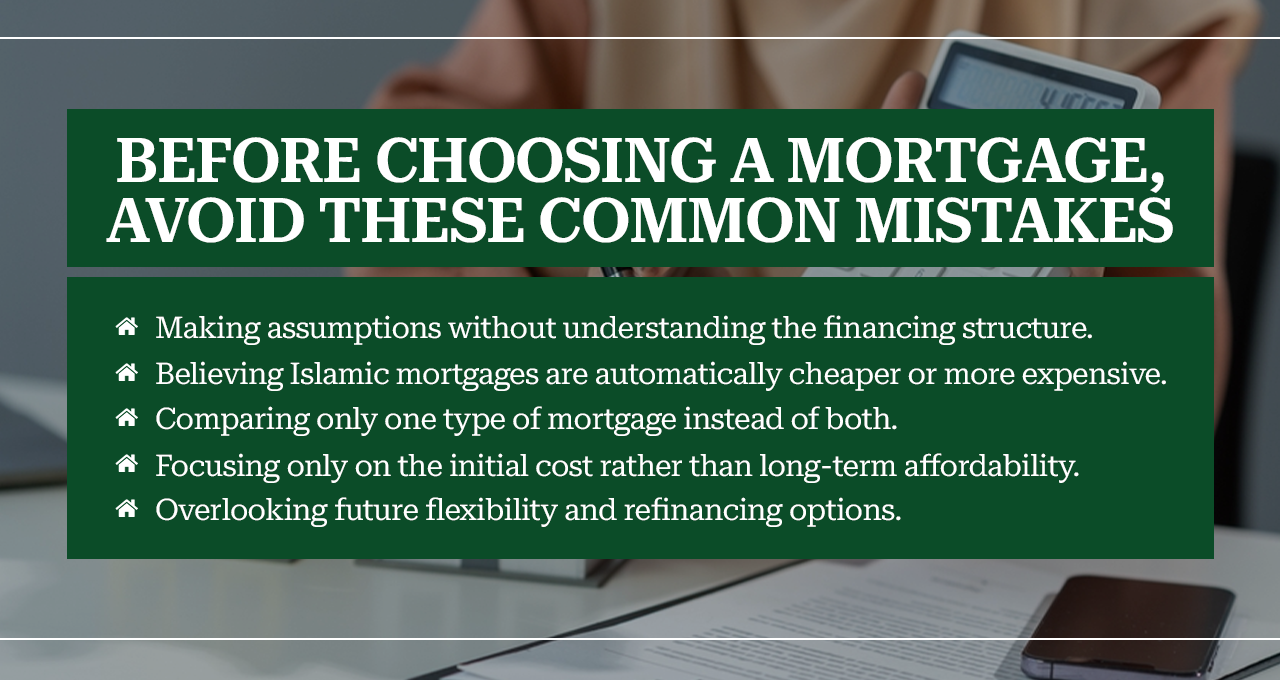
Before choosing a mortgage, avoid these common mistakes:
- Making assumptions without understanding the financing structure.
- Believing Islamic mortgages are automatically cheaper or more expensive.
- Comparing only one type of mortgage instead of both.
- Focusing only on the initial cost rather than long-term affordability.
- Overlooking future flexibility and refinancing options.
How Prime Rate Hub Can Help
Choosing between Islamic and conventional home finance is more than comparing rates. It requires understanding how each option supports your long-term financial goals.
At Prime Rate Hub, we help you:
- Compare Islamic and conventional mortgage options across more than 20 UAE banks.
- Understand the true cost and financing structure of each option.
- Match your requirements with the right lender.
- Structure your mortgage to suit your financial objectives.
- Guide you through every stage of the mortgage process.
Our goal is to help you make a confident, informed decision based on facts rather than assumptions.
For more, read this article: The Complete Guide to Property Finance in the UAE: From Islamic Mortgages to Property Valuation Services
Conclusion
Both Islamic and conventional mortgages are well-established home financing solutions in the UAE. The right option depends on your financial priorities, preferred financing structure, and long-term plans.
If you’re unsure which mortgage is best for your situation, Prime Rate Hub can help you compare your options and choose a solution that fits your needs with confidence.
Related guides and services
- Islamic (Shariah-compliant) mortgages in the UAE
- Islamic mortgage in Abu Dhabi
- Mortgage calculator
- Islamic Home Financing in Abu Dhabi: How Sharia-Compliant Mortgages Empower Modern Buyers
- Fixed vs Variable Mortgage in the UAE: Which Is Better in 2026?
- How Much Mortgage Can I Get in Abu Dhabi? (2026 Guide with Real Examples)
Frequently Asked Questions
Yes. Islamic mortgages are structured without interest and instead use profit-based financing models that comply with Shariah principles.
Not necessarily. In many cases, pricing is similar, although the financing structure differs.
Yes. Subject to lender approval, refinancing or a mortgage buyout may allow you to switch.
Not directly. However, their pricing may reflect similar market benchmarks while remaining Shariah-compliant.
The right choice depends on your financial goals, financing preferences, and the level of flexibility you require.
Yes, although eligibility criteria and available products may differ from those offered to UAE residents.
Yes. Early settlement is generally possible, but the terms vary between banks.
Approval is based on factors such as your financial profile, income, and eligibility rather than whether you choose Islamic or conventional financing.