



Want to know how a mortgage in Abu Dhabi works? Buying property in Abu Dhabi is a significant financial commitment, and for most buyers, securing a mortgage is an important part of the process.
Whether you are:
- A first-time buyer
- An expat resident
- A property investor
- A non-resident
Understanding how mortgages work in Abu Dhabi can help you plan your purchase with greater clarity. From eligibility and borrowing limits to interest rates, upfront costs and long-term planning, there are several factors to consider before committing to a property.
This guide covers the key things you need to know about getting a mortgage in Abu Dhabi in 2026.
How Do Mortgages Work in Abu Dhabi?
A mortgage is a loan provided by a bank to help finance the purchase of a property.
In the UAE, the basic structure is straightforward:
- The bank finances a percentage of the property’s value.
- You pay the remaining amount as a down payment.
- The property remains mortgaged to the bank until the loan is repaid.
Most mortgages typically include an initial fixed-rate period, followed by a variable rate linked to EIBOR.
Who Can Get a Mortgage in Abu Dhabi?
Mortgage eligibility in Abu Dhabi generally extends to:
- UAE Nationals
- Expat residents
- Non-resident investors
However, the requirements are not the same for every borrower. Financing limits, eligibility criteria and documentation requirements can vary depending on your residency status and financial profile.
How Much Can You Borrow for a Mortgage?
Your mortgage eligibility depends on several factors, including:
- Income
- Existing liabilities
- Credit profile
Banks also apply the Debt Burden Ratio (DBR), with a maximum of 50% of your monthly income.
Mortgage Borrowing Example
For example:
- AED 25,000 salary → approximately AED 1.5M–2M loan
- AED 40,000 salary → approximately AED 2.5M–3.5M loan
These figures illustrate how income can affect potential borrowing capacity.
What Is the Minimum Down Payment for a Mortgage in Abu Dhabi?
Based on UAE regulations:
- UAE Nationals → from 15%
- Expats → from 20%
- Non-residents → 40%+
Remember that your down payment is not the only upfront expense. You will also need additional funds to cover applicable fees and other property purchase costs.
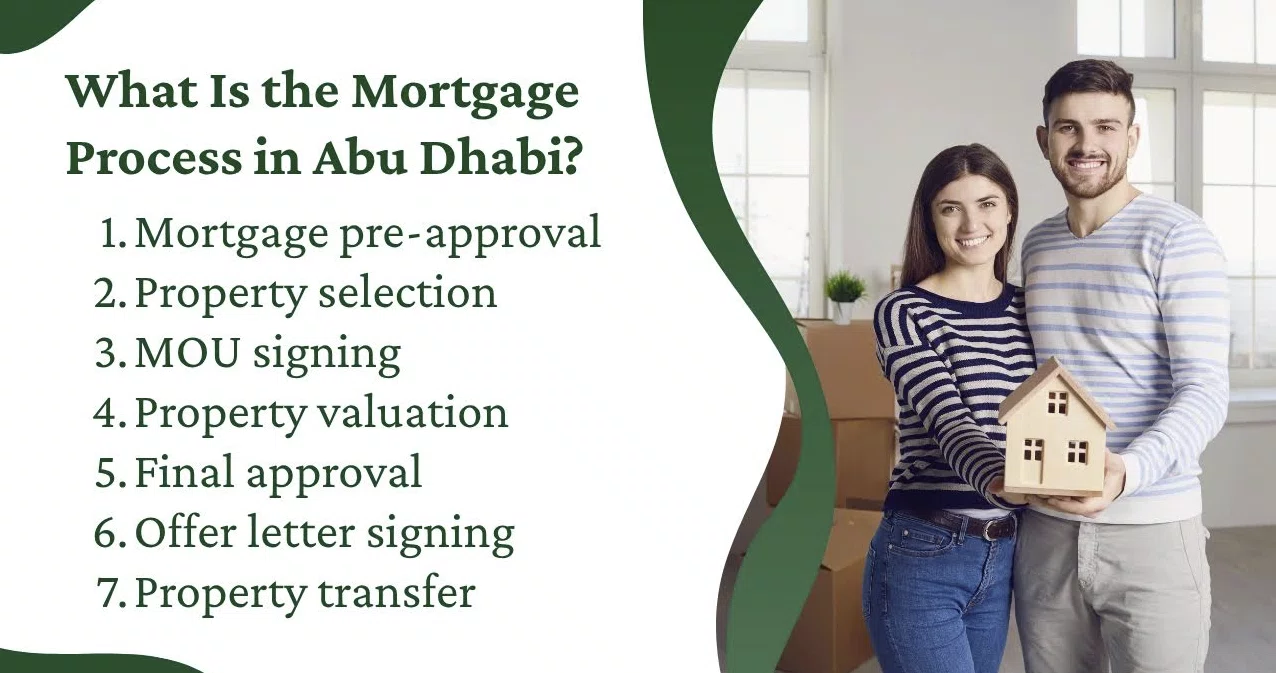
What Is the Mortgage Process in Abu Dhabi?
The mortgage process in Abu Dhabi generally follows a series of clear steps:
- Mortgage pre-approval
- Property selection
- MOU signing
- Property valuation
- Final approval
- Offer letter signing
- Property transfer
The typical timeline is 4 to 7 weeks, depending on the circumstances of the application and transaction.
What Types of Mortgages Are Available in the UAE?
Understanding the different types of mortgages in the UAE can help you identify which structure fits your circumstances.
1. Fixed-Rate Mortgage
A fixed-rate mortgage provides stable payments during the initial fixed-rate period.
2. Variable-Rate Mortgage
A variable-rate mortgage is linked to EIBOR, so the rate can change over time.
3. Islamic Mortgage
Islamic mortgages are Shariah-compliant and can be structured through options such as Murabaha or Ijara.
What Is EIBOR and How Does It Affect Your Mortgage?
EIBOR, or the Emirates Interbank Offered Rate, plays an important role in mortgage pricing in the UAE.
Once the initial fixed-rate period ends, your mortgage rate becomes:
EIBOR + bank margin
This means changes in EIBOR can affect your future mortgage payments.
Example: How a Rate Change Can Affect a Mortgage
For an AED 2,000,000 mortgage:
- A 0.25% change → approximately AED 10,000/year impact
- A 0.50% change → AED 20,000+ impact
This is why understanding the variable-rate component of your mortgage is important when planning for the long term.
What Are the Hidden Costs of Buying Property in Abu Dhabi?
The property price is only part of the total cost of buying a home. Buyers should also plan for expenses such as:
- Down payment
- Bank processing fee
- Valuation fee
- Transfer and registration fees
- Insurance
- Agent commission
Overall, additional costs can amount to 4%–7%+.
Planning for these expenses in advance can help prevent unexpected financial pressure during the property purchase.
How Does a Mortgage Differ for Different Types of Buyers?
Mortgage for First-Time Buyers
If you are purchasing your first property, it is useful to:
- Start with mortgage pre-approval
- Understand what you can realistically afford
- Avoid over-committing financially
Mortgage for Expats
Expats may receive up to 80% financing, with standard documentation requirements applying.
Mortgage for Non-Residents
Non-resident buyers may have financing of around 50%–65%, meaning a higher down payment is generally required.
Mortgage for Property Investors
For investors, mortgage planning should take factors such as rental yield and long-term financing strategy into account.
Can You Refinance or Buy Out an Existing Mortgage?
Taking a mortgage does not necessarily mean you are locked into the same arrangement forever.
Depending on your circumstances, options can include:
- Refinancing with the same bank
- Mortgage buyout by switching to another bank
- Equity release
These options can help reduce costs and improve cash flow.
What Are the Common Mortgage Mistakes to Avoid?
Several mistakes can make the mortgage process more difficult or expensive. Common ones include:
- Not getting pre-approved
- Ignoring additional costs
- Choosing the wrong bank
- Not reviewing your mortgage regularly
- Focusing only on the interest rate
Looking at the overall mortgage structure, rather than one factor in isolation, is important when making a long-term borrowing decision.
Why Does Mortgage Strategy Matter?
A mortgage is about more than simply getting approval.
Your mortgage can affect:
- Monthly cash flow
- Long-term savings
- Investment returns
Even small differences in the mortgage rate can result in significant savings over time. This makes it important to consider how the mortgage fits into your broader financial plans.
How Can Prime Rate Hub Help With Your Abu Dhabi Mortgage?
At Prime Rate Hub, we provide end-to-end mortgage advisory services to help simplify the process.
We can:
- Compare mortgage options across 20+ UAE banks
- Structure your mortgage correctly
- Support you through pre-approval and final approval
- Manage the process through to property transfer
- Provide ongoing mortgage reviews and advice
Our focus is on simplifying the mortgage journey and helping you make informed decisions based on your circumstances.
Conclusion: Planning Your Abu Dhabi Mortgage
Mortgages in Abu Dhabi are structured, accessible and flexible, but proper planning remains important.
Understanding mortgage eligibility, down payments, rates, EIBOR, additional costs and the application process can help you:
- Make better-informed financial decisions
- Avoid unnecessary delays
- Reduce long-term costs
Whether you are buying your first home, investing in property or purchasing as a non-resident, understanding your mortgage before committing can make the overall process easier to manage.
Frequently Asked Questions About Mortgages in Abu Dhabi
How long does it take to get a mortgage in Abu Dhabi?
A typical mortgage process takes around 4–7 weeks.
What is the minimum down payment for a mortgage in Abu Dhabi?
The minimum is 20% for expats and 15% for UAE Nationals.
What is EIBOR?
EIBOR is the benchmark rate that affects mortgage pricing in the UAE.
Can I refinance my mortgage?
Yes. Depending on your circumstances, you may be able to refinance or use a mortgage buyout to switch banks.
Are Islamic mortgages available in the UAE?
Yes. Islamic mortgage options are available across multiple UAE banks.
Can non-residents get a mortgage in Abu Dhabi?
Yes. Non-residents can obtain mortgages, although financing limits are generally lower.
What are the hidden costs of buying property?
Additional costs can be around 5%–7% of the property value, depending on the applicable expenses.
Should I use a mortgage broker?
A mortgage broker can help you compare banks and structure your mortgage correctly.