


Most home buyers naturally focus on one thing when comparing mortgages: how much will I pay each month? But UAE lenders look beyond the initial monthly payment.
Banks use a mortgage stress test to check whether you could continue to afford your property financing if interest rates rise, economic conditions change, or your monthly financial commitments increase. This additional assessment can affect how much you are able to borrow when buying a property in Abu Dhabi, Dubai, or elsewhere in the UAE.
You may read this article: Mortgage Pre-Approval in Abu Dhabi: What You Need, How It Works, and Why It Matters (2026 Guide)
Why Do UAE Mortgages Need a Stress Test?
Buying a property is already a major financial commitment. The last thing a homeowner wants is to find themselves struggling with mortgage payments if market rates increase after securing their loan.
That is why regulatory requirements and internal bank risk assessments include stress testing. The aim is to make sure borrowers have enough financial capacity to manage their mortgage under less favourable circumstances.
What Is a Mortgage Stress Test?
In the UAE, the Central Bank (CBUAE) requires banks to carefully assess a borrower’s ability to service their debt.
You may be offered an attractive introductory or promotional mortgage rate, but the bank does not necessarily use that rate alone when assessing your affordability. Instead, lenders calculate your Debt-Burden Ratio (DBR) using a higher, hypothetical interest rate.
Under UAE regulations, your DBR cannot exceed 50% of your verified monthly income.
The stress test provides a financial buffer in case interest rates increase after your initial fixed-rate period. It also helps lenders assess whether you can continue meeting your obligations without putting your finances under excessive pressure.
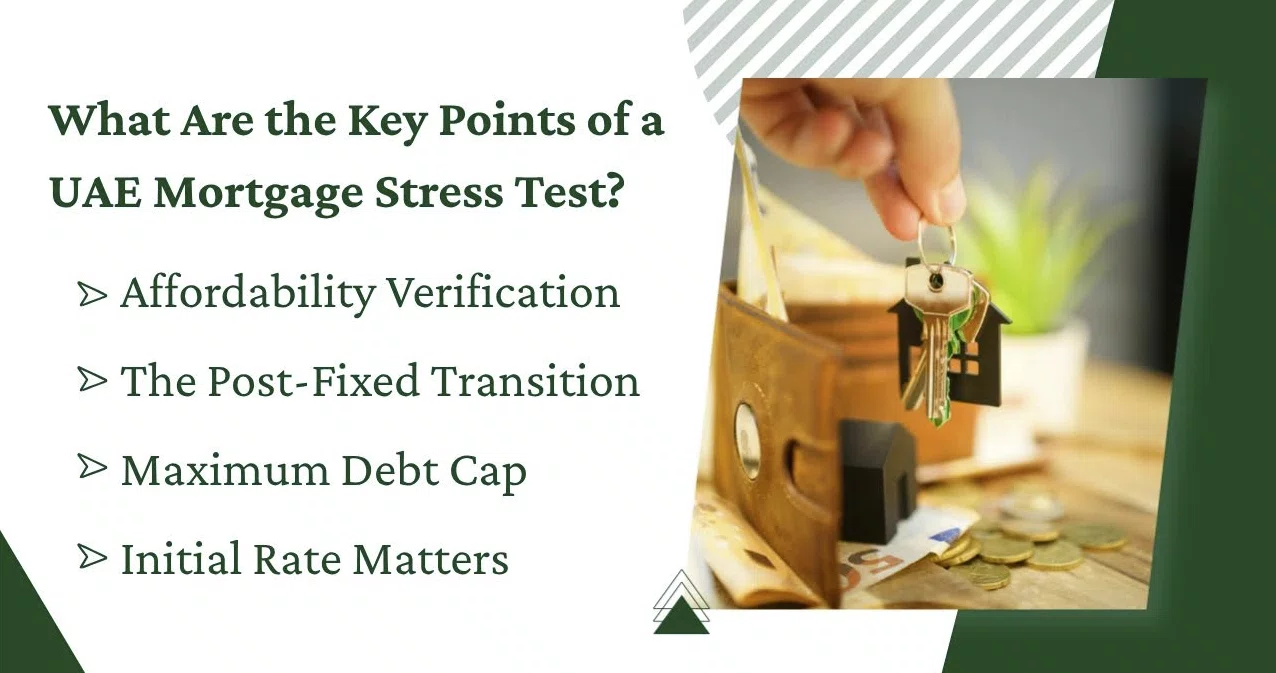
What Are the Key Points of a UAE Mortgage Stress Test?
There are several important things to understand about how mortgage stress testing works:
- Affordability Verification: Banks assess your borrowing capacity using a simulated higher interest rate rather than relying only on the introductory rate.
- The Post-Fixed Transition: For fixed or hybrid mortgages, the stress test considers your financial position against the eventual variable or follow-on rate.
- Maximum Debt Cap: Your total monthly liabilities, including credit cards, car loans, personal loans and the stress-tested mortgage payment, cannot exceed 50% of your income.
- Initial Rate Matters: A lower initial fixed mortgage rate can improve your overall qualification margins.
How Does the UAE Mortgage Stress Test Work? A Real Example
Consider a competitive hybrid mortgage structure available in today’s market:
- Initial Contract Rate: 3.95% fixed for the first 3 years
- Follow-On Rate: Variable rate based on 3-Month EIBOR + a 1.00% bank margin
- Applied Stress Test Rate: 4.59%
What Does This Mean for Your Mortgage?
If you apply for this mortgage, the bank will not calculate your 50% DBR limit using only the initial 3.95% fixed rate.
Instead, the bank applies the 4.59% stress rate across a maximum allowable tenure of 25 years when assessing your affordability.
For example, if the simulated monthly mortgage payment at 4.59%, combined with your existing credit card limits and active personal loans, takes your total monthly debt payments above 50% of your income, the bank may reduce the maximum loan amount you qualify for.
This is why the mortgage stress test can directly affect your purchasing power.
When Is a Mortgage Stress Test Applied in the UAE?
Traditional UAE banks generally apply these calculations during several major lending events.
1. New Property Purchases
The stress test can apply when purchasing either an off-plan property or a ready resale property in the secondary market.
2. Refinancing and Equity Release
If you modify an existing mortgage, extend the amortisation period, or release equity from an existing property, the bank may reassess your income and DBR capacity.
3. Mortgage Buyouts and Balance Transfers
Switching your outstanding mortgage balance to another bank to access better rates can also require a fresh assessment of your income and borrowing capacity.
How Can Prime Rate Hub Help With UAE Mortgage Stress Testing?
Understanding the lending requirements of more than 20 UAE banks can feel complicated, particularly when each borrower’s circumstances are different.
As an independent mortgage broker, Prime Rate Hub handles the mortgage process for property buyers and investors across the UAE. Based in Abu Dhabi, we provide mortgage advisory solutions for buyers looking to purchase property across the Emirates, including Abu Dhabi and Dubai.
To maximise your purchasing power under mortgage stress-testing requirements, there are several areas worth considering.
Optimise Your Credit Card Limits
UAE banks calculate DBR based on 5% of your total credit card limits, even when your current balance is zero.
Closing unused credit cards can therefore help increase your available borrowing capacity.
Clear Short-Term Liabilities
Paying off outstanding personal or auto loans can free up DBR capacity before you submit your formal mortgage application.
Secure a Low Base Mortgage Rate
Working with an independent mortgage advisor such as Prime Rate Hub allows you to compare options across lenders, including FAB, ADIB, ENBD and Dubai Islamic Bank.
Securing a lower contract rate can help ease your stress-tested ratios from the outset.