

For many buyers, getting mortgage approval in Abu Dhabi feels like the final step.
In reality, it is the beginning of a long-term financial commitment.
Once your mortgage is approved, the property is transferred and your mortgage is activated, the focus shifts from obtaining financing to managing it effectively.
Over time, your fixed-rate period may end, EIBOR may change, and new mortgage options may become available. Understanding these changes can help you make better financial decisions throughout the life of your mortgage.
Here is what you need to know after mortgage approval.
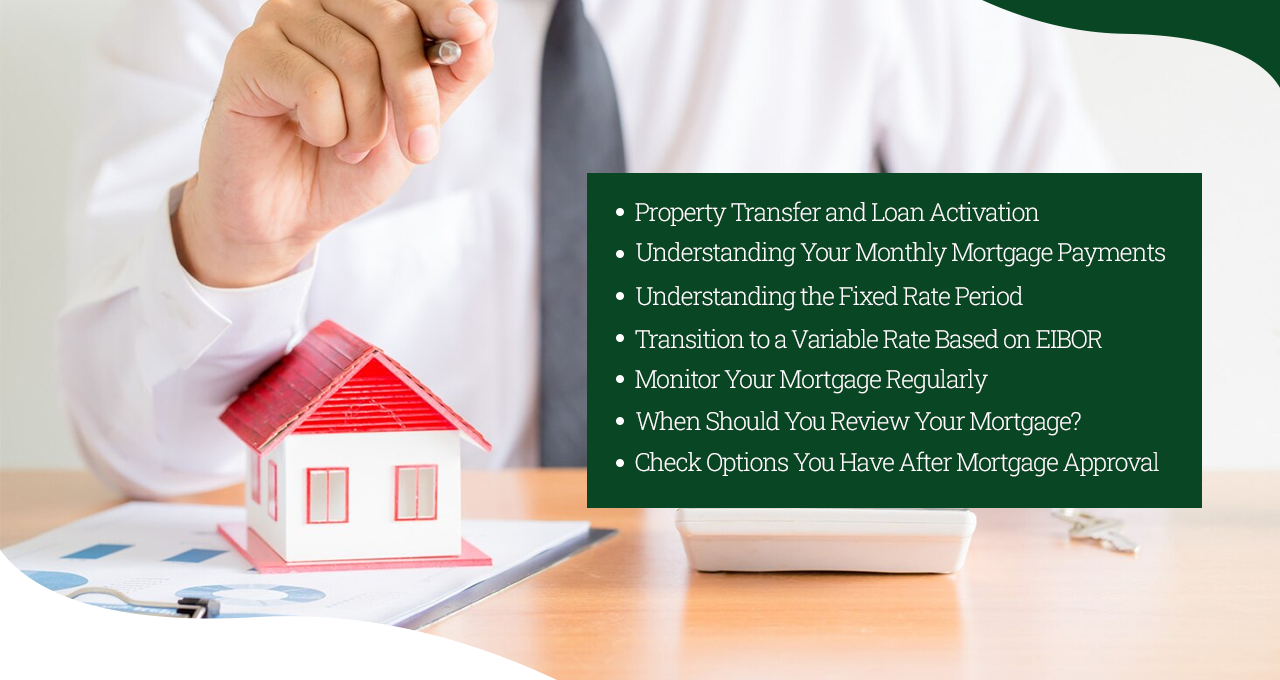
Step 1: Property Transfer and Mortgage Activation
After your mortgage receives final approval, the transaction moves toward completion.
Depending on the transaction, this generally includes:
- Completion of the required transfer formalities
- Bank disbursement
- Transfer of property ownership
- Mortgage registration
Once the mortgage is activated, your repayments begin according to the schedule agreed with your bank.
At this stage, it is important to keep copies of your mortgage documents, repayment schedule, property documents and insurance details for future reference.
Step 2: Understand Your Monthly Mortgage Payments
Your monthly mortgage payment generally consists of:
- Principal repayment
- Interest or profit
Insurance costs may also apply depending on the bank and mortgage structure.
Your monthly instalment is mainly affected by:
- Outstanding mortgage balance
- Interest or profit rate
- Remaining loan tenure
- Mortgage structure
Understanding these components makes it easier to track your mortgage and evaluate your options later.
Step 3: Know When Your Fixed-Rate Period Ends
Many mortgages in the UAE begin with a fixed-rate period, commonly between 1 and 5 years depending on the mortgage product.
During this period, the applicable rate generally remains fixed according to your mortgage agreement, providing greater predictability over your repayments.
The important date to remember is when your fixed-rate period ends.
After this date, your mortgage may move to the variable-rate structure specified in your agreement.
This is one of the most important times to review your mortgage rather than simply allowing the existing structure to continue without checking your options.
Step 4: Understand the Variable Rate and EIBOR
After the fixed-rate period, many UAE mortgages move to a variable rate based on:
EIBOR + Bank Margin
EIBOR stands for Emirates Interbank Offered Rate and is a benchmark rate used in the UAE financial market.
For example, if your mortgage is structured as:
3-Month EIBOR + 1% Bank Margin
and the applicable EIBOR is 3.5%, your mortgage rate would be approximately:
3.5% + 1% = 4.5%
If EIBOR rises, your applicable mortgage rate may increase.
If EIBOR falls, your applicable mortgage rate may decrease.
The actual change depends on the terms of your mortgage agreement.
How Much Can an EIBOR Change Matter?
Even a small difference in the applicable mortgage rate can become meaningful when the outstanding mortgage balance is large.
For a simple illustration using an outstanding mortgage balance of AED 2,000,000:
- A 0.25% rate difference represents approximately AED 5,000 per year
- A 0.50% rate difference represents approximately AED 10,000 per year
These figures are simple annualised illustrations based on the outstanding balance and rate difference. They are not exact changes in monthly mortgage repayments.
The actual impact depends on your outstanding balance, remaining tenure, repayment structure and mortgage terms.
Important: Check Your Minimum Floor Rate
A reduction in EIBOR does not always mean your mortgage rate will decrease by the same amount.
Some UAE mortgage products include a minimum floor rate, meaning the applicable mortgage rate cannot fall below a certain level even if EIBOR decreases.
Homeowners should therefore check the EIBOR benchmark, bank margin, minimum floor rate and reset terms stated in their mortgage agreement.
Step 5: Review Your Mortgage Regularly
One of the most common mistakes homeowners make is forgetting about their mortgage after the property transfer.
A mortgage can continue for many years, while interest rates, EIBOR and bank mortgage offers can change considerably during that period.
You should periodically review:
- Your current mortgage rate
- The end date of your fixed-rate period
- EIBOR movements
- Your bank margin and minimum floor rate
- Your outstanding mortgage balance
- Remaining loan tenure
- Mortgage options available in the market
- Changes in your financial circumstances
A mortgage that was competitive when you purchased your property may not necessarily remain competitive several years later.
Step 6: When Should You Review Your Mortgage?
There is no reason to change your mortgage every time interest rates move.
However, a review becomes particularly important when:
- Your fixed-rate period is approaching its end
- Your mortgage moves to a variable rate
- EIBOR changes significantly
- Better mortgage terms become available
- Your income or financial circumstances change
- You want to reduce your monthly payment
- You are considering accessing equity from your property
Reviewing your mortgage at least once a year can help you understand whether your existing structure remains suitable.
Step 7: What Options Do You Have?
After your mortgage has been running for some time, you may have several options.
1. Continue With Your Existing Mortgage
If your existing mortgage remains competitive and suitable for your financial circumstances, staying with your current structure may be the right decision.
Changing your mortgage is not automatically better.
2. Review or Reprice With Your Current Bank
Before moving your mortgage, you may be able to discuss your existing pricing or structure with your current bank.
The options available will depend on the bank’s policy and the terms of your mortgage agreement.
3. Refinance or Mortgage Buyout
If another bank provides a more suitable mortgage structure, you may consider refinancing by transferring the outstanding mortgage to the new bank.
However, the new rate should not be considered in isolation.
You should compare the potential savings against costs such as:
- Early settlement fees
- Processing fees
- Property valuation
- Mortgage registration
- Other applicable switching costs
The objective is to determine whether changing banks produces a real financial benefit after all costs are considered.
4. Equity Release
If your property value has increased and you meet the bank’s eligibility requirements, you may be able to access part of the available equity in your property.
The amount available will depend on factors such as the current property valuation, outstanding mortgage balance, applicable financing limits, affordability and individual bank policy.
Don’t Look at the Interest Rate Alone
A lower advertised mortgage rate does not automatically mean it is better to refinance.
When reviewing your mortgage, consider:
- New mortgage rate
- Fixed-rate period
- Bank margin after the fixed period
- Minimum floor rate
- Early settlement costs
- Processing and valuation fees
- Mortgage registration costs
- Remaining loan tenure
- Total expected savings
The correct question is not simply:
“Which bank has the lowest mortgage rate?”
The better question is:
“Will changing my mortgage actually save me money after all costs are considered?”
Common Mistakes Homeowners Make
Some common mistakes after mortgage approval include:
- Forgetting when the fixed-rate period ends
- Ignoring EIBOR movements
- Not knowing the applicable bank margin or floor rate
- Remaining on an uncompetitive rate without reviewing alternatives
- Focusing only on the advertised interest rate
- Refinancing without calculating the total cost of switching
- Extending the mortgage term only to achieve a lower monthly payment
- Never reviewing the mortgage after completion
A lower monthly payment does not always mean a lower total mortgage cost.
How Prime Rate Hub Supports Clients After Mortgage Approval
At Prime Rate Hub, our relationship with clients does not necessarily end when the property transfer is completed.
We can support homeowners by:
- Reviewing their existing mortgage structure
- Monitoring EIBOR and mortgage market developments
- Comparing mortgage options across 20+ UAE banks
- Assessing refinancing and mortgage buyout opportunities
- Comparing potential savings against switching costs
- Reviewing equity release options
- Supporting the mortgage process when a change is financially suitable
The objective is not to refinance every mortgage.
Sometimes remaining with your existing bank is the better option. In other situations, repricing, refinancing or a mortgage buyout may provide a meaningful financial benefit.
The important step is to review the numbers before making the decision.
Related guides and services
- New purchase, resale and final payment financing
- Mortgage closing costs in the UAE
- Mortgage calculator
- Hidden Costs of Buying Property in Abu Dhabi: What Buyers Must Know (2026 Guide)
- Mortgage Process in Abu Dhabi: Step-by-Step Guide for Buyers (2026)
- How EIBOR Drives Mortgage Pricing: Understanding Low-Interest Mortgage in Abu Dhabi
Frequently Asked Questions
After final mortgage approval, the transaction moves toward property transfer, mortgage registration and bank disbursement. Your mortgage repayments then begin according to the agreed repayment schedule.
The exact first-payment date depends on the bank’s disbursement and repayment schedule. You should check the date specified in your mortgage documentation.
Not necessarily. If your mortgage has a fixed-rate period, the applicable rate generally remains fixed during that period. Afterward, it may move to a variable-rate structure, depending on your mortgage agreement.
EIBOR stands for Emirates Interbank Offered Rate. It is a UAE benchmark rate used as a reference for financial transactions, including many variable-rate mortgages.
When your mortgage is linked to EIBOR, changes in the benchmark can affect your applicable mortgage rate.
Not necessarily. Your mortgage may also have a bank margin, minimum floor rate and specific rate-reset terms. These conditions determine how an EIBOR movement affects your actual mortgage rate.
Yes, subject to eligibility, bank approval and applicable costs. Refinancing or a mortgage buyout can allow another bank to settle your existing mortgage and take over the financing.
Reviewing your mortgage at least once a year is a sensible approach, particularly when your fixed-rate period is approaching its end or market rates change significantly.
Potentially. Repricing, refinancing, mortgage buyout or restructuring may reduce your monthly payment depending on the rate, outstanding balance and remaining tenure.
However, the total mortgage cost should always be considered rather than focusing only on the monthly instalment.
Conclusion
Mortgage approval and property transfer are important milestones, but they are not the end of your mortgage journey.
Over the life of your mortgage, EIBOR, interest rates, bank offers and your own financial circumstances can change.
Understanding your mortgage structure, knowing when your fixed-rate period ends and reviewing your options periodically can help you make better long-term financial decisions.
Sometimes the right decision will be to refinance or move your mortgage to another bank.
Other times, keeping your existing mortgage will make more financial sense.
The important thing is to understand your mortgage, review the numbers and make the decision based on the overall financial benefit.