


By Yamen Mustafa, Senior Mortgage Advisor – Prime Rate Hub
Imagine finding the UAE property you have been looking for while living thousands of kilometres away. The property fits your investment plans, the location is right, and you are ready to move forward. Then one important question comes up: “Can I get a mortgage in the UAE if I do not live there?”
The answer is yes. Several UAE banks provide mortgage solutions for eligible non-resident buyers. However, the process can be different from financing available to UAE residents. Banks may apply different financing limits, eligibility criteria, documentation requirements and property restrictions. Understanding these requirements before committing to a property can help you plan your purchase more effectively.
Can Non-Residents Get a Mortgage in the UAE?
Yes. Several UAE banks provide mortgage or home-finance solutions specifically for non-resident buyers. For example, Dubai Islamic Bank currently operates a dedicated non-resident home-finance program, while Abu Dhabi Islamic Bank also provides non-resident home financing for eligible salaried and self-employed applicants. If you prefer Shariah-compliant financing, see our guide to Islamic mortgages in Abu Dhabi.
However, not every bank accepts every nationality, country of residence, income type or property. Eligibility can depend on:
- Country of residence
- Nationality
- Income level
- Employment or business profile
- Source of income
- Credit history
- Property type and location
- Individual bank policy
This is why identifying suitable lenders before submitting applications is particularly important for non-resident buyers. Our overview of UAE mortgage eligibility explains the basics.
How Much Can Non-Residents Borrow?
There is no single financing percentage that applies to every non-resident mortgage in the UAE. The maximum financing available depends on the lender, applicant profile and property. Some non-resident programs may offer financing around 50%–65% of the property value, while certain products can provide higher financing for eligible applicants. For example, Dubai Islamic Bank currently advertises non-resident home finance of up to 75% for eligible customers.
The actual amount approved depends on the bank’s assessment of your income, affordability, property and overall financial profile. To get a rough idea first, read how much mortgage you can get in Abu Dhabi or try our mortgage calculator.
How Much Down Payment Will You Need?
Because financing levels vary, the required down payment also varies. As a simple example:
- If a bank finances 60% of the property value, you would need to contribute approximately 40% from your own funds.
- If financing reaches 70%, the required contribution would be approximately 30%.
In addition to the down payment, budget separately for transaction-related costs such as valuation, registration, agency fees and other applicable charges. Our guides to the mortgage down payment in the UAE and mortgage closing costs break these down, and hidden costs of buying property in Abu Dhabi covers the rest. Your down payment should be calculated for the specific mortgage product you qualify for, not a single standard percentage.
What Do Banks Look for in Non-Resident Applicants?
For non-resident applicants, banks need to assess income and financial information that may originate outside the UAE. They typically consider:
- Stable and verifiable income
- Employment or business history
- Country of residence
- Credit history
- Existing liabilities
- Source of funds
- Overall repayment capacity
For self-employed applicants, banks may also assess company ownership, turnover, financial performance and business banking history. Requirements vary considerably between lenders. For example, Abu Dhabi Islamic Bank currently states minimum eligibility criteria for its non-resident program, including a monthly salary requirement for salaried applicants and minimum annual turnover for self-employed applicants.
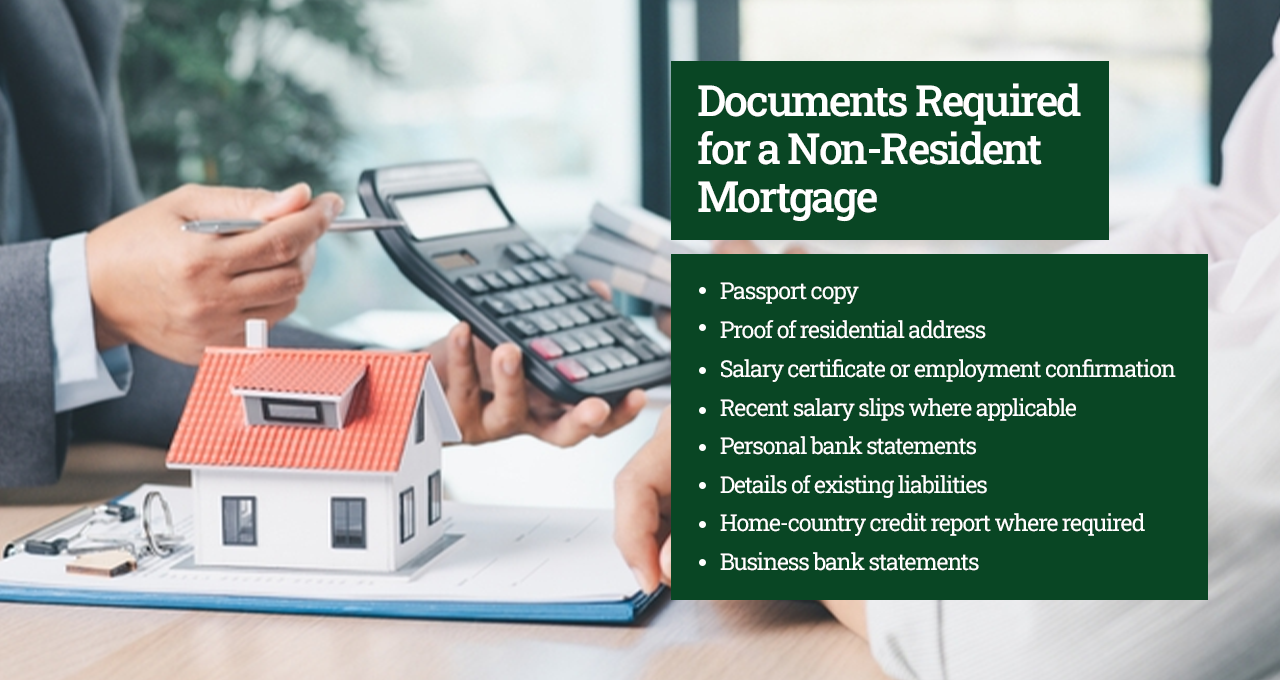
Documents Required for a Non-Resident Mortgage
Documentation requirements vary by bank and country of residence, but applicants may be asked to provide:
- Passport
- Proof of residential address
- Salary certificate or employment confirmation
- Recent salary slips where applicable
- Personal bank statements
- Details of existing liabilities
- Home-country credit report where required
- Company documents for self-employed applicants
- Business bank statements
- Property documentation once a property is selected
Some documents may also need certification, verification or additional clarification depending on the country where they were issued. Preparing complete documentation early can significantly reduce delays.
Do Non-Residents Need a UAE Bank Account?
Some banks may require a UAE bank account as part of the mortgage or repayment setup. The requirement varies by lender and product. Confirm early whether a local account needs to be opened and what documentation is required to establish it.
Are Mortgage Rates Higher for Non-Residents?
Mortgage pricing for non-residents can differ from resident pricing. The rate offered depends on:
- Bank
- Customer profile
- Loan-to-value ratio
- Property
- Fixed-rate period
- Bank margin
- Product structure
Rather than assuming every non-resident mortgage is automatically more expensive, compare the complete financing structure for your profile. See the latest UAE mortgage rates for context. A low introductory rate is not the only consideration: understand what happens after the fixed-rate period and whether the mortgage moves to an EIBOR-linked variable structure.
How Does EIBOR Affect a Non-Resident Mortgage?
Many UAE mortgages use EIBOR as part of their variable-rate pricing after an initial fixed-rate period. The structure may be:
EIBOR + Bank Margin
If your mortgage uses this structure, changes in EIBOR can affect your applicable rate over time. The exact impact depends on the mortgage agreement, including the bank margin, EIBOR tenor, reset frequency and any applicable minimum floor rate. Understand both the introductory fixed rate and the long-term pricing structure before choosing a mortgage.
How Long Can a Non-Resident Mortgage Run?
Mortgage tenure depends on the bank, applicant age and product. Some UAE home-finance products offer terms of up to 25 years. Dubai Islamic Bank, for example, advertises home-finance tenure of up to 25 years across parts of its home-finance range. For non-residents, the tenure offered may be shorter depending on age at maturity and individual bank policy. A longer tenure can reduce the monthly instalment, but it can also increase the total financing cost over time.
Which Properties Can Non-Residents Finance?
Property eligibility is an important part of a non-resident mortgage. Banks may finance:
- Ready properties
- Resale properties
- Completed developer properties
- Properties in approved developments
The exact list depends on the bank. Dubai Islamic Bank’s non-resident program, for example, specifically includes resale and secondary-market purchases as well as ready purchases from developers. For how resale and developer payments are financed, see new purchase, resale and final payment mortgages.
Check property eligibility before signing a binding purchase agreement. A financially eligible buyer can still face difficulties if the selected property is not accepted by the lender. If you are looking in Abu Dhabi, browse mortgage options by Abu Dhabi area.
What About Off-Plan Property?
Non-resident buyers should not assume that every under-construction property can be financed in the same way as a ready property. Off-plan financing is product- and project-specific. Some lenders now provide off-plan financing for eligible developments and applicants. Dubai Islamic Bank, for example, announced a new off-plan home-finance proposition in August 2026 offering financing of up to 50% for eligible UAE nationals, residents and non-residents on qualifying freehold projects.
Availability depends heavily on the developer, project, construction stage and individual bank policy, so check it case by case rather than assuming it.
Common Challenges for Non-Resident Buyers
Non-resident applications can be more complex because they involve cross-border income and documentation. Common challenges include:
- Fewer suitable lenders
- Country-specific bank policies
- Foreign income verification
- Credit-history verification
- Currency differences
- Additional documentation
- Remote coordination
- Property eligibility restrictions
None of these automatically prevents approval, but they make lender selection and document preparation more important. If you are an expat who has recently moved, our guide for expats buying in Abu Dhabi may fit you better.
Common Mistakes to Avoid
- Assuming every UAE bank accepts non-residents
- Choosing a property before confirming likely financing
- Assuming one standard LTV applies to all banks
- Underestimating the required cash contribution
- Submitting incomplete or unverifiable documents
- Ignoring currency exposure if income is earned outside the UAE
- Comparing only the introductory interest rate
- Applying to several unsuitable banks without understanding their eligibility criteria
A more effective approach is to understand your likely financing position first and then structure the property purchase around it.
Step-by-Step Non-Resident Mortgage Process
The exact process varies, but a typical non-resident mortgage follows these stages. For the general sequence, see our UAE mortgage process guide.
Step 1: Initial Eligibility Assessment
Your income, liabilities, country of residence, employment or business profile and intended property purchase are reviewed.
Step 2: Bank Selection
Banks that accept your particular non-resident profile are identified and compared.
Step 3: Document Preparation
Income, banking, credit and identification documents are collected and checked.
Step 4: Mortgage Pre-Approval
The selected bank reviews your financial profile and determines the indicative financing amount.
Step 5: Property Selection and Valuation
Once the property is identified, the bank confirms property eligibility and arranges a valuation.
Step 6: Final Mortgage Approval
The bank reviews the valuation and remaining conditions before issuing final approval.
Step 7: Documentation, Transfer and Disbursement
Once all requirements are completed, the financing proceeds toward property transfer, mortgage registration and disbursement. Read what happens after mortgage approval for the next steps.
How Long Does a Non-Resident Mortgage Take?
There is no guaranteed timeline because non-resident applications vary significantly. A straightforward case may typically take several weeks from initial application through final approval and completion. The timeframe depends on:
- Applicant profile
- Country of residence
- Document availability
- Bank
- Property valuation
- Property documentation
- Additional verification requirements
Rather than expecting an exact timeline, allow sufficient time for additional documentation or cross-border verification.
How Prime Rate Hub Supports Non-Resident Buyers
For an international buyer, the challenge is often not whether mortgage financing exists. The challenge is identifying which banks will accept your particular profile and structuring the application correctly. Prime Rate Hub can support non-resident buyers by:
- Assessing initial mortgage eligibility
- Identifying suitable UAE banks
- Comparing available mortgage structures
- Reviewing documentation before submission
- Coordinating applications with the selected lender
- Managing bank follow-up while the client is overseas
- Supporting valuation and final mortgage approval
- Coordinating the mortgage process through completion
This makes the financing process more structured even when the buyer is based outside the UAE. Explore our full range of mortgage solutions or speak to a mortgage advisor about your case.
Frequently Asked Questions
Can non-residents get a mortgage in Abu Dhabi?
Yes. Several UAE banks provide mortgage or home-finance solutions for eligible non-residents purchasing property in Abu Dhabi. Eligibility depends on the buyer’s financial profile, country of residence, property and bank.
What is the maximum financing for a non-resident?
There is no single maximum that applies to every lender. Some products may be around 50%–65%, while certain lenders can offer higher financing to eligible non-resident customers.
Do non-residents need a UAE bank account?
Some banks require a UAE account for mortgage servicing or repayments. Confirm the requirement with the selected lender.
Can self-employed non-residents obtain a mortgage?
Yes, with certain banks. Self-employed applicants generally need to provide additional company, financial and banking documents, and the eligibility criteria may differ from salaried applicants.
Can non-residents buy a resale property with a mortgage?
Yes. Some UAE banks provide non-resident financing for eligible resale and secondary-market properties.
Can non-residents finance off-plan property?
In some cases, yes, but this depends on the bank, developer and project. Check it specifically rather than assuming it is generally available.
Can a non-resident refinance a UAE mortgage later?
Potentially, yes. Refinancing or mortgage-buyout options depend on the homeowner’s financial profile, property, outstanding balance and lender requirements at that time. See our guide on refinance, buyout and equity release.
How long does a non-resident mortgage take?
A straightforward transaction can take several weeks, but timing varies according to the bank, documentation, property and any cross-border verification required.
More questions? Visit our mortgage FAQ.
Conclusion
Buying property in the UAE as a non-resident does not necessarily mean paying the entire purchase price in cash. Mortgage options are available through several UAE banks, but non-resident financing requires careful planning because eligibility, financing levels, documentation and property acceptance differ considerably between lenders. Before committing to a property, understand:
- Which banks accept your profile
- How much financing may be available
- How much cash you need to contribute
- What documentation is required
- Whether the property is accepted by the lender
- How the mortgage will be priced over the long term
The better prepared you are before purchasing, the easier it becomes to structure the transaction around realistic financing rather than trying to solve financing problems after committing to the property.